

June 2026Larson Maddox UK Legal Team12 min read
Do UK Lawyers Still Take a Pay Cut to Move In-House?

Last Updated: June 2026
The analysis is informed by Larson Maddox’s UK in-house and private practice legal recruitment teams, based on UK placement data, live mandates and compensation discussions across 2025 and 2026.
Most lawyers treat the move in-house as a settled trade: less money in return for better hours, closer involvement with the business, and a more sustainable career.
That trade-off has not disappeared, but it has become more selective. It still applies at newly qualified level. It also applies to lawyers leaving New York firms and the highest-paying US practices in London, where the salary gap remains too large for most in-house roles to close.
The change is most visible in the middle of the market. At mid-level, the pay cut is no longer automatic. In financial services, technology and parts of life sciences, in-house offers are now close enough to parts of the private practice market that bonus, pension, benefits and equity can change the outcome. For some lawyers, the move is still a cut. For others, it is flat. For a smaller group, it is a pay rise.
The short answer: sometimes, but not always
At newly qualified level, in-house salaries still sit well below private practice salaries. The gap also remains significant for lawyers leaving New York firms and the highest-paying US practices in London.
At five to seven years’ PQE, the answer depends more on the lawyer’s current firm category and the sector they are moving into. In financial services, technology and life sciences, in-house offers can overlap with parts of the private practice market once bonus, pension, benefits and equity are included.
The most useful comparison is not private practice versus in-house in general. It is the lawyer’s current salary, the destination sector and the full value of the offer.
About the data
The salary ranges in this article draw on two Larson Maddox UK compensation guides: the UK Private Practice Compensation Guide and The UK In-House Legal: All Industries Compensation Guide.
Both guides are informed by market activity seen by Larson Maddox’s regulatory and legal recruitment specialists, including real placement data, active mandates and compensation discussions with lawyers and hiring teams.
The private practice guide covers West End and UK firms, international firms, Silver Circle, Magic Circle, New York firms and other US firms operating in the UK. The in-house guide covers financial services, life sciences & healthcare, energy, construction & infrastructure, manufacturing & consumer goods, and technology, media & telecoms.
The figures should be read as market benchmarks rather than fixed salary rules. Compensation will vary by location, firm category, sector, PQE, role scope, reporting line, bonus structure, equity participation and candidate profile.
Where the in-house pay cut still applies
At newly qualified level, in-house still pays well below private practice. That has not changed.
Private practice NQ salaries now range from £95,000 at some international firms to around £185,000 at New York firms in London. In-house NQ salaries sit between £65,000 and £90,000 across the main sectors Larson Maddox tracks.
That is a real cut. It is also why the old view of the market has lasted as long as it has. Junior lawyers comparing a law firm salary with an in-house offer are usually looking at a lower base, a smaller immediate earning trajectory and less certainty around future compensation.
The same is true at the top of the firm market. A five to seven PQE lawyer at a New York firm earning around £300,000 base is not usually going to find an in-house role that matches that number. Even a strong bonus, pension contribution or equity plan rarely closes a gap that large below General Counsel level.
That is why the old view of in-house pay has not disappeared. It still holds at either end of the salary curve, but it is less reliable for lawyers sitting between them.
UK private practice lawyer salary benchmarks in 2026
Private practice still sets the upper end of UK legal pay, but it does not give every lawyer the same financial starting point. The salary a lawyer is moving from depends heavily on firm category.
Private practice salary benchmarks by firm category
|
Firm category |
NQ base salary |
5-7 PQE base salary |
Bonus range |
|
International |
£95,000-£120,000 |
£130,000-£165,000+ |
10-30% |
|
West End & UK |
£115,000-£145, 000 |
£150,000-£180,000 |
5-10% |
|
Silver Circle |
£120,000-£135,000 |
£145,000-£160,000+ |
10-30% |
|
Magic Circle |
£150,000 |
£180,000-£210,000+ |
10-30% |
|
Other US Firms |
£160,000-£180,000 |
£180,000-£210,000+ |
10-30% |
|
New York Firms |
~£185,000 |
~£300,000 |
10-35% |
Source: Larson Maddox UK Private Practice Compensation Guide. Benchmarks are based on real placement data and market insight from Larson Maddox’s UK legal and regulatory recruitment specialists.
Figures are intended as guidance and may vary by firm, practice area, location, role scope, bonus structure and candidate profile.
For the full breakdown of UK private practice salary and bonus benchmarks, download the Larson Maddox UK Private Practice Compensation Guide.
The spread at NQ level is around £90,000 between the lowest paying international firms and New York firms in London. By five to seven years’ PQE, that spread has widened further. A Silver Circle senior associate earns £145,000–£160,000+ base, while a peer at a New York firm at the same PQE is closer to £300,000.
When a lawyer asks whether moving in-house means a pay cut, the first question is: a cut from what?
For someone at an international firm, a senior in-house move can mean more money. For someone leaving a New York firm, the same role can mean losing a third or more of their salary.
UK in-house Legal Counsel salary benchmarks by sector
For Legal Counsel and Senior Legal Counsel roles, salary differences are usually more sector-led than title-led. A similar-sounding in-house role can carry a very different package depending on whether it sits in financial services, TMT, life sciences, infrastructure or consumer goods.
In-house legal salaries start below private practice, but the gap does not stay fixed as lawyers become more senior.
In-house legal counsel salary benchmarks by sector
|
Sector |
NQ base salary |
5-7 PQE base salary |
Bonus range |
|
Manufacturing & Consumer Goods |
£65,000-£80,000 |
£100,000-£130,000 |
10-35% |
|
Energy, Construction & Infrastructure |
£70,000-£90, 000 |
£105,000-£140,000 |
10-35% |
|
Technology, Media & Telecoms |
£70,000-£85,000 |
£125,000-£160,000 |
10-35% |
|
Life Sciences & Healthcare |
£75,000-£90,000 |
£120,000-£160,000 |
10-35% |
|
Financial Services |
£75,000-£90,000 |
£150,000-£195,000 |
10-45% |
Source: Larson Maddox UK In-House Legal: All Industries Compensation Guide. Benchmarks are based on real placement data and market insight from Larson Maddox’s UK legal and regulatory recruitment specialists.
Figures vary by sector, business size, reporting line, bonus history, equity participation and candidate profile.
For sector-specific in-house legal salary data, download the Larson Maddox UK In-House Legal Compensation Guide.
The spread becomes much more pronounced once lawyers move beyond the junior end of the market. Financial services reaches £195,000 at the top of the range, while manufacturing and consumer goods tops out at £130,000. That leaves a £65,000 gap between two in-house roles at the same PQE, before bonus, pension, benefits or equity are counted.
The title may be similar, but the compensation market behind it is not.
Why the in-house pay gap is narrowing in some sectors
From what we are seeing in the market, the better comparison is no longer simply private practice versus in-house. Private practice pay is still largely shaped by firm category. In-house pay is shaped more heavily by sector, regulatory exposure, business size and how close the legal role sits to commercial decision-making.
In financial services, technology and life sciences, legal teams are often closer to regulated growth, product risk, data exposure, investigations, complex contracting and board-level decision-making. These businesses are not just paying for someone to review contracts or manage external counsel. They are paying for lawyers who can make judgement calls quickly, work with senior stakeholders and reduce the business's reliance on law firms. That shift in expectation has moved in-house mandates in these sectors closer to the complexity profile that was once reserved for senior private practice work, and the pay has followed.
How bonus, pension and equity affect total compensation
The bonus ranges narrow the gap in some places, but they do not remove the starting point problem.
In private practice, the bonus column is fairly compressed outside the New York firms. West End and UK firms sit at 5–10%. International, Silver Circle, Magic Circle and other US firms mostly sit at 10–30%. New York firms move higher at the senior associate end, reaching 30–35%.
In-house bonuses follow a similar pattern, with one clear outlier. Most sectors sit in a 10–35% range. Financial services run higher, reaching 45% at the senior end. That makes the package more competitive, but only where the base salary is already close enough for the variable element to matter.
Bonus can move the outcome for a lawyer leaving an international, West End or Silver Circle firm for a higher-paying in-house sector. It is much less likely to change the outcome for someone leaving a New York firm.
Pension, benefits and equity then sit on top of that. Across our recent placements, the strongest in-house offers have often carried higher employer pension contributions than the equivalent firm role, broader benefits, and in some listed businesses, LTIP or restricted stock. Those elements matter most in the close comparisons. They do not turn every in-house offer into a competitive one.
Total compensation: two worked examples
The two examples below are based on placement patterns we have observed across 2025 and 2026. Both use midpoint outcomes rather than the top of the range, so they should be read as illustrative comparisons rather than fixed salary rules. Pension contributions are modelled at illustrative employer rates and will vary by organisation.
Example 1: Silver Circle senior associate moving to financial services in-house
| Component | Silver Circle | Financial Services In-House |
| Base Salary | £155,000 | £170,000 |
| Bonus | £31,000 | £51,000 |
| Employer Pension Contribution | £7,750 | £20,400 |
| Benefits | £1,500 | £4,000 |
| Total Package | £195,250 | £245,400 |
At this point in the market, the in-house move is not a discount. The total package is roughly £50,000 ahead before any LTIP element.
Example 2: New York firm senior associate moving to TMT in-house
| Component | New York Firm | TMT In-House |
| Base Salary | £300,000 | £160,000 |
| Bonus | £75,000 | £56,000 |
| Employer Pension Contribution | £15,000 | £16,000 |
| Benefits | £2,000 | £4,000 |
| LTIP, annualised | - | £20,000 |
| Total Package | £392,000 | £256,000 |
Here, the stronger in-house benefits do not get close to closing the gap. The move still means giving up around £136,000 in total compensation.
Both examples sit in the same market. The result changes because the starting salary and the destination sector are different.
For employers, the implication is clear. An in-house title does not automatically justify a discount if the role is being hired from private practice.
Where a business wants a private practice-trained lawyer, the package needs to be benchmarked against the candidate pool it wants to reach, not only against internal salary bands.
Private practice vs in-house salary: where does the gap narrow?
The clearest overlap between private practice and in-house salary is at five to seven years’ PQE, and even then it is concentrated in the higher-paying in-house sectors.
Financial services is the strongest example. Based on Larson Maddox’s UK in-house compensation data, five to nine PQE financial services legal roles can reach £150,000–£195,000 base, with bonus potential of 25–45%. That can compete with, or exceed, parts of the international, West End, UK and Silver Circle market, depending on the lawyer’s current firm and wider package.
Technology, media and telecoms, and life sciences and healthcare, also overlap with parts of the firm market at five to seven years’ PQE, with base salary ranges of £125,000–£160,000 and £120,000–£160,000 respectively. That does not put them close to New York firm salaries, but it does change the calculation for lawyers leaving international, UK, West End or some Silver Circle roles.
Where in-house pay can rival private practice
At five to seven years’ PQE, in-house compensation can rival parts of the private practice market, particularly in financial services, technology and life sciences.
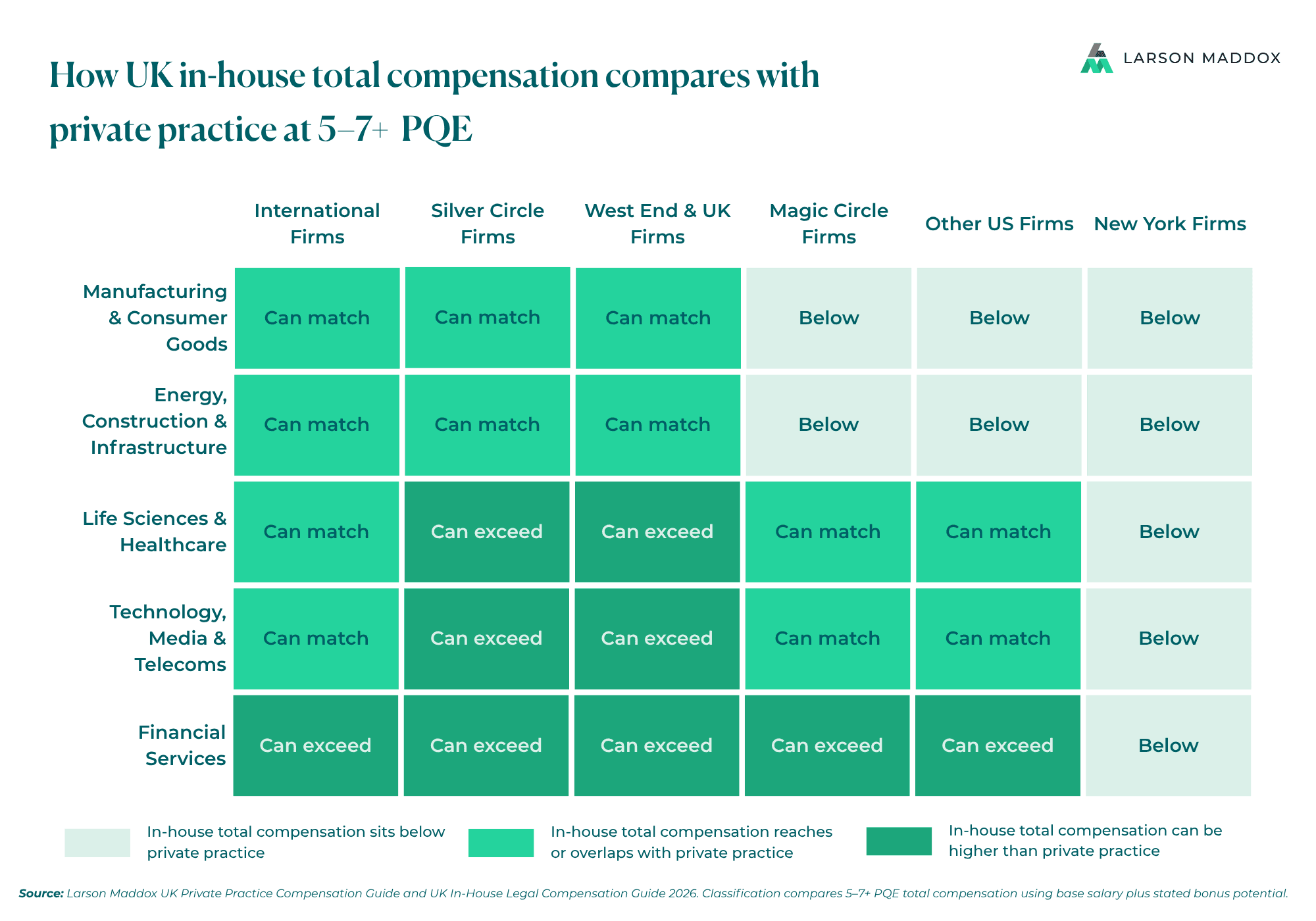
Financial services is the only in-house sector that can exceed several private practice categories on base salary alone. Technology, media and telecoms and life sciences overlap with parts of the firm market, but do not change the position at the top. New York salaries remain outside the normal in-house range below GC.
General Counsel pay in the UK
GC pay sits in a different range from the rest of the in-house market.
General Counsel salary benchmarks by sector
|
Sector |
GC base salary |
GC bonus |
|
Manufacturing & Consumer Goods |
£150,000-£240,000+ |
25-40% |
|
Energy, Construction & Infrastructure |
£180,000+ |
25-40% |
|
Technology, Media & Telecoms |
£160,000-£280,000+ |
30-50% |
|
Life Sciences & Healthcare |
£180,000-£300,000+ |
30-50% |
|
Financial Services |
£250,000+ |
30-100% |
Source: Larson Maddox UK In-House Legal Compensation Guide, 2026.
GC compensation varies significantly by business size, ownership structure, regulatory exposure, international scope and whether equity or long-term incentive arrangements are included.
The higher end of the market is found at listed companies, regulated businesses and groups with significant international exposure. Financial services remains the highest-paying sector, with GC base salaries starting at £250,000 and bonus structures running from 30% to 100% of base.
At this level, the rest of the package also becomes more important. LTIPs, share options and co-investment terms are more common than they are in roles below GC, particularly in listed businesses, private equity portfolio companies and private credit funds.
GC compensation is not just a senior version of the PQE bands above it. The lawyer is being paid to lead the function, manage external risk, advise the board and sit close to commercial decision-making.
How to tell if an in-house offer is properly priced
A strong in-house offer should make sense before negotiation starts. The salary, reporting line and work profile should all point to the same level of seniority.
The warning sign is a gap between the brief and the budget. If a business wants a private practice-trained lawyer to advise senior stakeholders, run complex matters, manage external counsel and operate with limited supervision, the package needs to reflect that.
The issue is not always negotiation. Sometimes the role has simply been priced below the market it wants to hire from.
In the offers Larson Maddox has benchmarked across 2025 and 2026, the strongest packages have usually been the ones where the business has priced the role against the market it is actually hiring from. A financial services business trying to hire from a Silver Circle or international firm cannot benchmark the role in the same way as a manufacturing business hiring from an existing in-house team. The source of the candidate matters.
A lower base salary can still make sense, but only where the role gives something clear in return: a stronger sector platform, broader commercial exposure, meaningful bonus or equity, or a credible route towards Head of Legal or General Counsel. A role that asks for senior-level capability while offering limited authority, vague progression and speculative upside should be treated with caution.
For lawyers assessing an offer, the useful questions are practical:
|
Question to ask |
What it tells you |
|
How was the salary range set? |
Whether the business has benchmarked against the right candidate pool |
|
Which firms or sectors has the business successfully hired from at this level? |
Whether the budget matches the market it wants to access |
|
How have recent hires at this level been paid? |
Whether the offer is consistent with current internal and external benchmarks |
|
How often has the bonus paid out at target? |
Whether the variable pay should be treaded as likely compensation or upside |
|
What pension, equity or LTIP arrangements apply? |
Whether the full package changes the base salary compensation |
|
What work will stay with external counsel? |
How much responsibility the lawyer will actually own |
|
Who will the lawyer advise day to day? |
Whether the role has real stakeholder access |
|
What is the next step from this role? |
Whether progression is credible or just implied |
If the answers do not support the salary, the issue may not be negotiation. It may be that the role has been priced below the level of responsibility being requested.
For lawyers considering a move, live legal roles can show how businesses are currently positioning salary, reporting line and responsibility across both in-house and private practice markets.
So are UK lawyers still taking a pay cut to move in-house?
The gap has not disappeared. It has split.
At newly qualified level, in-house compensation still sits clearly below private practice. For lawyers leaving New York firms or the highest-paying US practices, most in-house roles remain out of reach below General Counsel level. Between those points, there is no single pattern. Outcomes move with the firm a lawyer is leaving, the sector they are entering and the wider package attached to the role.
Benchmark your move
A pay cut is only clear when the offer is measured against the right market.
For lawyers, that means comparing the full package against the firm category they are leaving, the sector they are entering and the work the role is expected to own.
For employers, it means pricing the role against the candidate pool they want to reach, not only against internal salary bands.
Larson Maddox benchmarks private practice and in-house legal compensation across the UK. For the salary and bonus data behind this article, download the UK Private Practice and the UK In-House Legal Compensation Guides. To compare your package against current opportunities, register with Larson Maddox for role updates or explore live legal and compliance roles.
About Larson Maddox
Larson Maddox is a specialist legal and regulatory talent partner. In the UK, our teams work across private practice, in-house legal, compliance and General Counsel hiring, giving us visibility across the firm salaries lawyers are leaving, the sector-led packages businesses are offering, and the seniority levels where competition for legal talent is strongest.

Still searching for your dream role?
Our team of expert consultants are dedicated to helping you find your next career-defining opportunity today.
Let’s talk talent
Need the right talent for your next hire, or guidance on your people strategy? Leverage our experience to help you and your business today.
Frequently Asked Questions About In-House Lawyer Pay in the UK
Yes, usually at newly qualified level, but not across the whole market. The gap is also significant for lawyers leaving New York firms or the highest-paying US practices in London. At five to seven years’ PQE, the answer depends more on the lawyer’s current firm category, the sector they are moving into and the wider compensation package.
Financial services is typically the highest-paying in-house legal sector in the UK, particularly at mid-level and General Counsel level. Technology, media and telecoms, and parts of life sciences and healthcare, can also offer competitive packages, especially where bonus, pension, benefits or equity are included.
The in-house pay gap tends to narrow most clearly at around five to seven years’ PQE. At this level, lawyers moving from international, West End, UK, Silver Circle or some Magic Circle firms into higher-paying in-house sectors may find that the total package is closer to, or in some cases ahead of, their private practice compensation.
Yes, in some parts of the market. A senior associate moving from a UK, West End, international or Silver Circle firm into a higher-paying in-house sector may receive a comparable or stronger total package once bonus, pension, benefits and equity are included. It is much less likely for lawyers leaving New York firms at the same PQE.
Lawyers should compare base salary, bonus history, pension, benefits, equity, reporting line, progression, sector platform and the level of responsibility attached to the role. The most useful comparison is not private practice versus in-house in general, but the specific package against the market the role is hiring from, the sector it sits in and the level of responsibility it carries.
In Larson Maddox's in-house salary benchmarks, mid-level Legal Counsel roles in financial services reach £150,000–£195,000 base at five to seven PQE. The higher mid-level ranges are usually found in financial services, technology and life sciences, particularly where the role involves regulatory exposure, complex commercial work or senior stakeholder responsibility.
There is no single answer, but five to seven PQE is when the compensation comparison tends to become most competitive, particularly for lawyers moving into financial services or TMT. At this stage, lawyers often have enough private practice experience to be attractive to in-house legal teams, but they may not yet be so far up the law firm salary scale that most in-house roles cannot compete. The right answer still depends on the firm they are leaving, the sector they are entering and the wider package.
Lawyers at five to seven years’ PQE moving from international, West End, UK, Silver Circle or some Magic Circle firms into higher-paying in-house sectors are least likely to face a clear pay cut. Financial services, technology and life sciences are the sectors where in-house packages most often come closer to private practice. Lawyers leaving New York firms are much more likely to see a significant reduction below General Counsel level.