

October 2026Larson Maddox6 min read
Career Path for an Associate General Counsel

Last Reviewed: October 2026
An Associate General Counsel (ACG) is a senior in-house lawyer who leads a major legal area, business division or regional legal function. The role usually sits above Legal Counsel or Senior Legal Counsel and combines legal expertise with commercial advice, risk management and leadership responsibility.
The route to Associate General Counsel differs by organisation and jurisdiction. The move usually comes when a lawyer can advise senior stakeholders independently, manage complex legal risk and take ownership beyond a single matter or specialism.
Where Associate General Counsel sits in the in-house legal hierarchy
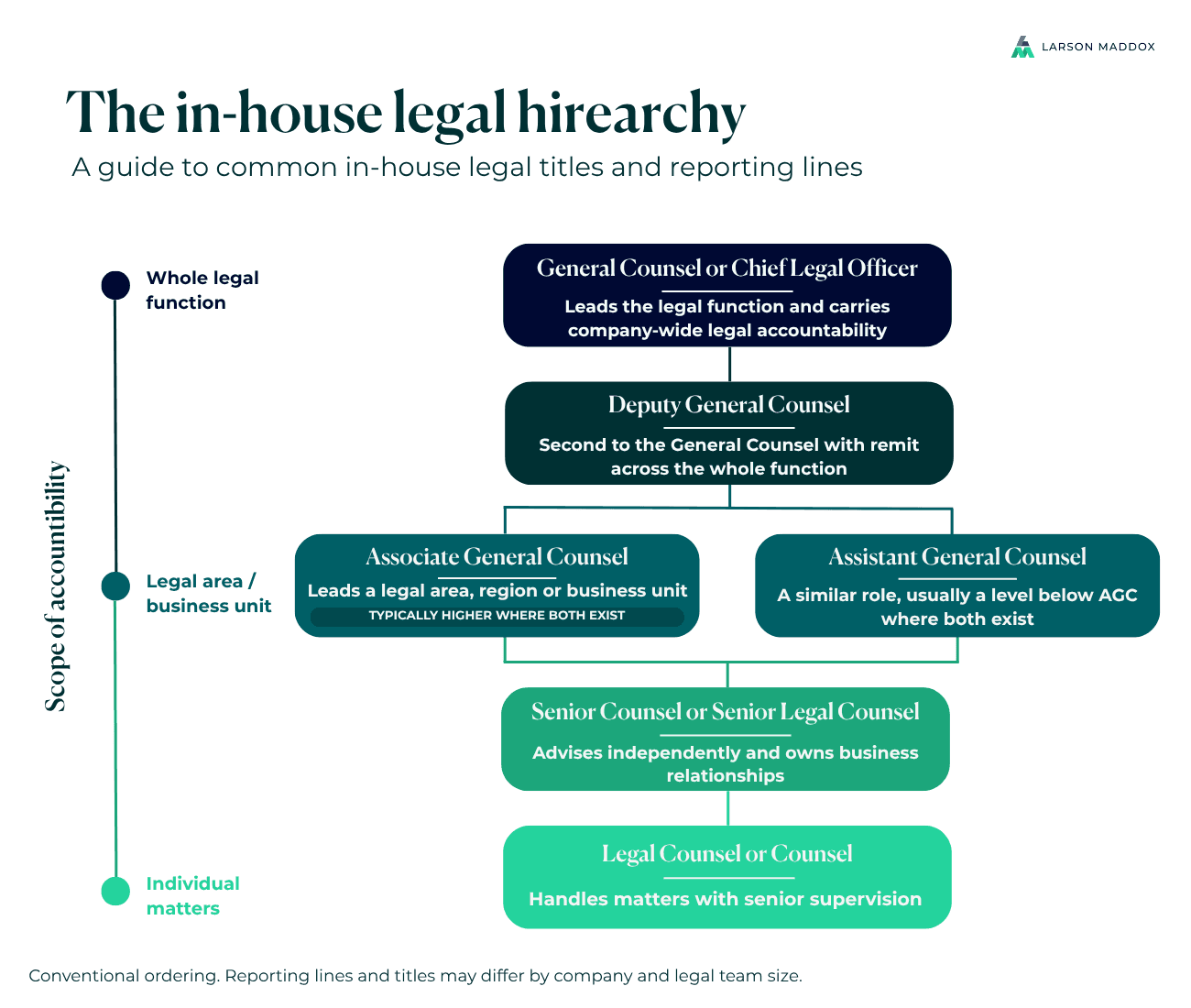
In most in-house legal teams the Associate General Counsel reports to the General Counsel, or to a Deputy General Counsel in larger functions, and leads a defined part of the legal work. The conventional ordering runs General Counsel or Chief Legal Officer at the top, then Deputy General Counsel, then Associate General Counsel, then Assistant General Counsel, with Senior Counsel and Counsel below. Few companies use every layer, and the titles are not applied consistently across the market.
Assistant General Counsel is the title most often confused with Associate General Counsel. The two are sometimes used interchangeably. Where a company uses both, Associate usually ranks higher, though some companies reverse the order. Others avoid General Counsel-derived titles below the top job altogether and use titles such as Senior Legal Counsel and Managing Counsel instead.
In-house legal hierarchy
What does an Associate General Counsel do?
An Associate General Counsel leads one part of a company’s legal function and is accountable to the General Counsel for the legal risk within it. The role combines advisory work with management, and a typical remit includes the following.
- leading a legal area, region or business unit
- advising executive and commercial stakeholders
- managing external counsel, legal spend or disputes
- translating regulation into practical business decisions
- managing and developing the lawyers in the team
- escalating material risk to the General Counsel or the leadership team
The balance depends on the company and the area. An AGC covering regulatory affairs at a bank may spend most of the week on regulator engagement and policy, while an AGC covering commercial at a technology company may run a contracts team. The title is the same but the day-to-day work can look very different.
Job descriptions for corporate AGC roles are fairly consistent on the basics. They ask for a JD, active bar admission in good standing, and anywhere from five to more than ten years of practice, with the number depending on the area the role covers and the size of the team. The roles Larson Maddox advertises at this level usually report to the General Counsel and are built around a defined practice area or business unit. Where job descriptions differ is on the reporting line, the size of the team, the budget and whether the AGC sits on the division’s leadership team, and those details decide how big a step the role is. Our guide to deciding whether a legal job offer is worth taking covers how to weigh them.
How to become an Associate General Counsel
The most common routes are promotion within an in-house team, often from Legal Counsel through Senior Legal Counsel, or a move from private practice into a Counsel or Senior Counsel role before progressing internally.
Most in-house lawyers have done some of both. In the ACC and Empsight 2025 Law Department Compensation Survey of 1,632 US in-house lawyers, 77 percent reported prior law firm experience before moving in-house, while 16 percent reported moving directly in-house after law school.
From Legal Counsel to Associate General Counsel
At Legal Counsel level the focus is on the legal work itself. Matters usually come through a more senior lawyer and advice is reviewed before it goes to the business. A Senior Legal Counsel is expected to advise without that review and to own the relationship with a business team or a product line, including instructing outside counsel on their own matters.
The move to Associate General Counsel is where responsibility widens from individual matters to a whole area. The AGC leads a practice area or a business unit and is accountable to the General Counsel for the legal risk within it, including the priorities of the lawyers working in it. The commercial side of the role grows at the same time, and an AGC is expected to contribute to business decisions as they are made as well as advise on the legal position.
In our experience this is often the harder step, because it is the first role where a lawyer is judged on the performance of a team and an area rather than on their own work. Lawyers who want to make it benefit from taking on some management or budget responsibility beforehand, such as supervising a junior lawyer or managing an outside counsel budget, so there is something to point to during a long interview process.
From private practice to Associate General Counsel
Most moves from a law firm into an in-house team tend to happen at mid-level, often between three and seven years of practice, and the lawyer usually joins as Legal Counsel or Senior Counsel and reaches AGC from inside. A direct move from a firm into an AGC seat does happen, generally for a senior associate or counsel with a specialism the company needs, such as privacy or securities.
Firm training tends to count in a lawyer’s favour. Private practice gives a stronger technical grounding early on, and the same ACC survey found that in-house lawyers with law firm experience earned more on average than those without it, at both attorney and Chief Legal Officer level. What a firm does not usually provide is the commercial exposure that in-house roles build from the outset, which is one reason the first in-house role often sits a level below where firm seniority might suggest.
If you are in private practice and weighing the move, our guide covers what changes in the work and the pay when you go in-house.
What comes after Associate General Counsel
The usual next step is Deputy General Counsel or General Counsel, depending on how the company’s legal function is structured. Companies with a Deputy role tend to fill it from their AGCs, and in smaller functions the AGC may move straight into the General Counsel seat when it becomes vacant, or into a General Counsel role elsewhere.
What tends to separate the AGCs who make that move is exposure to the parts of the job the role does not usually include. Board exposure is the clearest example, even on a single matter. Experience running the function as a whole helps too, such as managing the legal budget or the outside counsel panel, or covering for the General Counsel during leave. Governance work is relevant because many General Counsel roles include corporate secretary duties, and a risk remit that extends into compliance or regulatory affairs can broaden the profile further.
There is no fixed tenure at AGC level before the step, and some lawyers stay at the level by choice, since the General Counsel role in a large company is a different job with more board and regulatory work. The breadth of an AGC role can also open up senior legal and risk leadership opportunities in regulated industries.
For the General Counsel role itself, including how the title varies and what a General Counsel search looks for, see our guide to what a General Counsel does and how the role has changed. Our General Counsel salary guide covers why pay at that level varies so widely.
Mapping out your move to Associate General Counsel
Our in-house legal team works with Legal Counsel and Senior Legal Counsel looking for a wider remit, with private practice lawyers making their first in-house move, and with Associate General Counsel preparing for a Deputy or General Counsel role. If that is where you are, register with Larson Maddox and our consultants can match you to in-house roles at the right level, or browse our live associate general counsel roles to see what is currently open.
Still searching for your dream role?
Our team of expert consultants are dedicated to helping you find your next career-defining opportunity today.
Let’s talk talent
Need the right talent for your next hire, or guidance on your people strategy? Leverage our experience to help you and your business today.
Frequently Asked Questions
An Associate General Counsel is a senior in-house lawyer who leads a legal area, region or business division within a company’s legal function. The role sits above Legal Counsel and Senior Legal Counsel and usually reports to the General Counsel.
An Associate General Counsel advises executive and commercial stakeholders, manages the lawyers and outside counsel working in their area, turns regulation into business decisions and escalates material risk to the General Counsel. The balance of the work depends on the company and the area the AGC covers.
Yes. Associate General Counsel is a senior leadership role in an in-house legal team. It sits below Deputy General Counsel and General Counsel and usually carries responsibility for a team and a defined area of legal risk.
The titles are often used interchangeably. Where a company uses both, Associate General Counsel usually ranks above Assistant General Counsel, although some companies reverse the order. Both report to the General Counsel or a Deputy and lead a defined area of legal work.
A Deputy General Counsel usually has a remit across more of the legal function and acts as second to the General Counsel, while an Associate General Counsel leads one part of it. Some companies use only one of the two titles.
General Counsel are usually appointed from Deputy or Associate General Counsel roles. The experience that tends to count most is board exposure, leadership of the wider legal function, governance work and a risk remit beyond pure legal. There is no fixed tenure at AGC level before the step.